
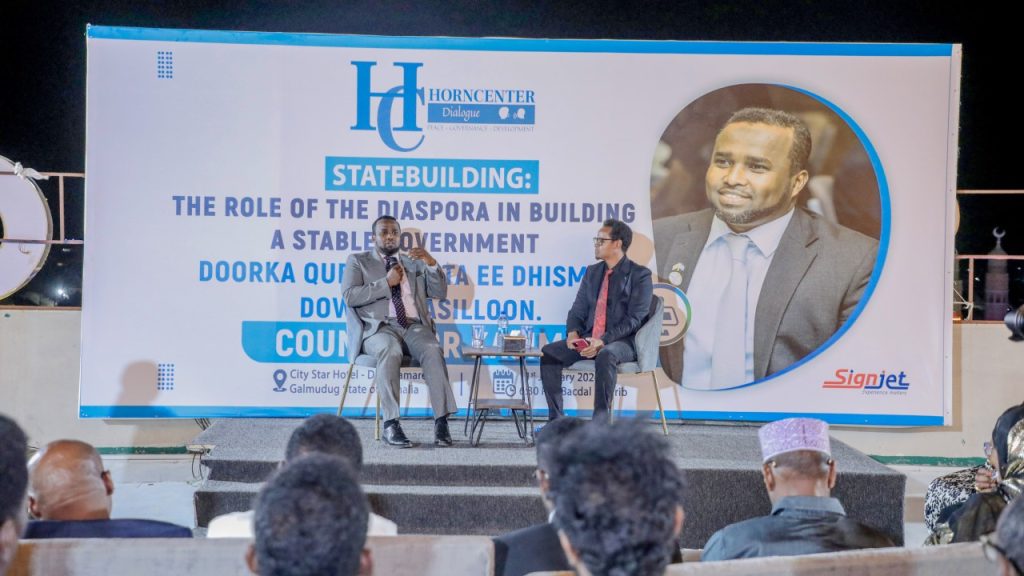
I have spent the past six years working on peacebuilding and governance in Galmudug — developing programmes, participating in high-level dialogue forums, and collaborating with government institutions to translate policy into tangible change for local communities. Therefore, when I say that the conversation we hosted on 11 January 2026 was one of the most meaningful I have moderated, that is not just a formality.
Our Quarterly Platform featured a guest I have long wanted to hear from in this format: Kasim Ali — a Somali-British governance specialist, former adviser to President Hassan Sheikh Mohamud, and elected councillor and party leader in the UK. The theme was statebuilding and the diaspora’s role. What followed was two hours of honest, sometimes uncomfortable, and genuinely valuable dialogue.
Here is what stayed with me.
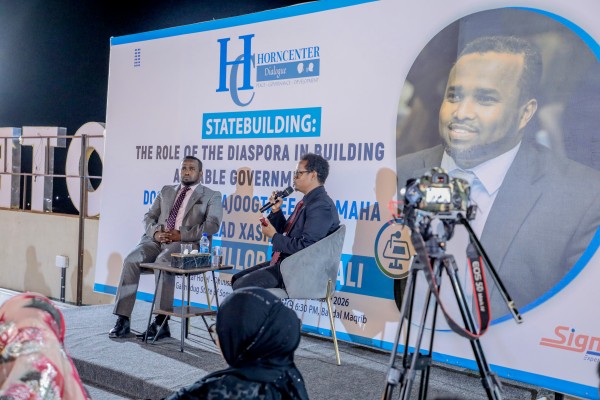
A candid shot of both of us in mid-discussion
1. The diaspora has more to offer than money — and it’s time we said so clearly
In my work on the Road to Sustainable Peace and Good Governance (R2P) project, I repeatedly see discussions about the diaspora quickly collapse into a conversation about remittances. How much are they sending? Is it going to the right places?
Kasim Ali reframed this entirely. He described a Somali diaspora professional who had spent years within the UK’s local government system — learning its procedures, accountability structures, and inter-agency dynamics — and then deploying that knowledge back into his own community. He did not just send money. He stood for election. He won a ward. He led a party.
“I stood for election because I wanted to use the knowledge I gained in the country where I was educated. I saw a problem in my community and decided to act.” — Kasim Ali
After years of facilitating community engagement dialogues in Galmudug, this resonated deeply with me. The deficit in Somalia is not only financial. It is institutional. And the diaspora holds institutional knowledge that has accumulated over decades.
2. Federalism only works when everyone agrees on one thing
As someone working in Galmudug — a regional state navigating its relationship with Mogadishu and its own districts simultaneously — I was particularly interested in how Kasim Ali described the UK’s approach to multi-tier governance.
His answer was deceptively simple: it works because everyone from central to local government operates under the same principle — the national interest takes priority. Not the party’s interest. Not the region’s interest. The nation’s.
Three pillars he identified for effective cooperation
- Shared accountability — aligned financial reporting across all tiers
- Collaboration — joint planning and implementation between levels
- Transparency — genuine public access to decisions
In my programme work — including our decentralisation and civic education initiatives — this maps directly onto the challenges I encounter daily. The structural framework is part of Somalia’s federal model. What is still being built is the culture of cooperation that makes the framework function.
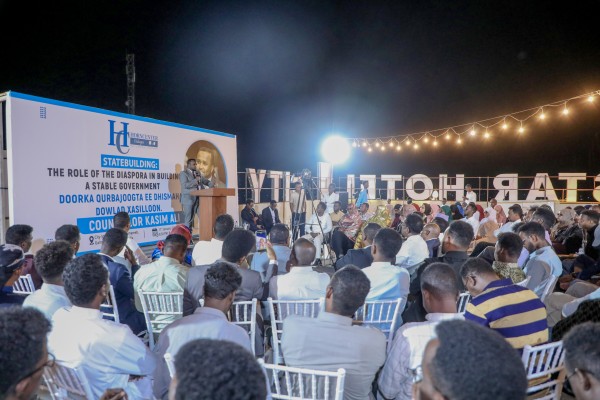
Captures the deliberative atmosphere of the dialogue session
3. The hardest question of the evening — who is funding the conflict?
One of our panellists, Liiban, raised something that rarely gets said directly in forums like this: some members of the Somali diaspora are not funding development — they are financing clan militias. And they are doing it while living comfortably abroad.
Having worked in conflict-affected communities in Galmudug, this is not abstract to me. I have seen the aftermath. I have sat with community leaders trying to rebuild trust after violence that was bankrolled from outside. Kasim Ali did not dismiss the issue or soften it. He traced it to four decades of grievance, resource scarcity, and broken inter-clan trust — and called for structured research and civic education as part of the answer.
“We need to go back to the root causes — grievance, resource scarcity, mistrust — and address them through evidence and public education, not just condemnation.”
This aligns directly with the R2P programme’s approach. Sustainable peace is not achieved through statements. It requires communities that understand the causes of their own conflict and are equipped to build alternatives
4. Leadership capacity is not optional — it is the bottleneck
One of the participants and a member of the Galmudug civil society, Ubah Hassan Ugaas, raised a question I think about in my own programme design: as Somalia moves toward one-person, one-vote elections, are candidates being prepared to actually govern if they win?
Kasim Ali’s response matched something I have observed across years of institutional strengthening work: the gap between winning a seat and effectively occupying it is enormous — and it is a gap that training can close. He described plans to work through the UK Embassy and partner organisations to deliver structured leadership and governance training to elected officials at every level.
From where I sit — having designed and implemented capacity building programmes for government institutions in fragile environments — this is exactly the right framing. Technical skills, strategic planning, and intergovernmental cooperation are learnable. What is needed is the will and the infrastructure to teach them systematically.
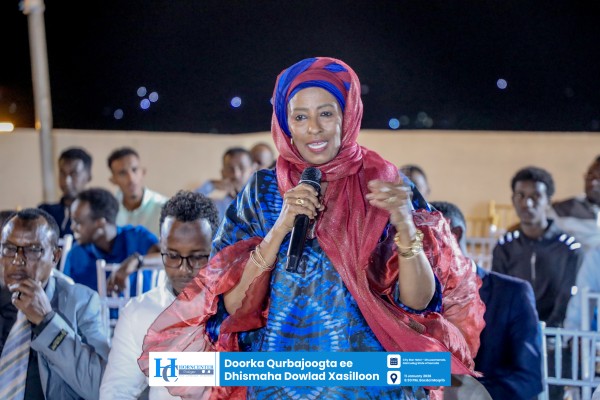
Halimo Ismael Ibrahim (Halimo Yarey), former Galmudug Independent Electoral Body chair, asking questions to the panelists.
5. 70% of the population, almost none of the power
Diib Cardofe put a number on a problem we rarely confront directly: Somalia is approximately 70% youth, yet young people are almost entirely absent from governance structures. This is not a pipeline problem. It is a structural exclusion problem.
Kasim Ali was direct about the consequence: a country that fails to bring its youth into legitimate political processes will lose them to illegitimate ones. In my peacebuilding work, I have seen this dynamic play out. Young men with no pathway into governance, employment, or civic life become recruits. The solution is not motivational — it is institutional.
“If we fail to bring young people into governance, the long-term future of the country will be diminished.”
6. Women, peace, and the cost of getting this wrong
Minister of Women and Human Rights of Galmudg, Sofia Saldeeye, highlighted an important issue that deserves more attention: the exclusion of youth from opportunities and the exclusion of women from governance are not separate crises. They are interconnected. When young men are drawn into conflict, women and vulnerable communities bear the brunt — disproportionately, repeatedly, and without sufficient institutional support.
Women’s participation in peacebuilding and governance is not a mere checkbox. In every high-level dialogue I have taken part in across Galmudug — on reconciliation, on decentralisation, on civic education — the most lasting results have stemmed from processes in which women’s voices shaped the agenda rather than simply endorsing it.
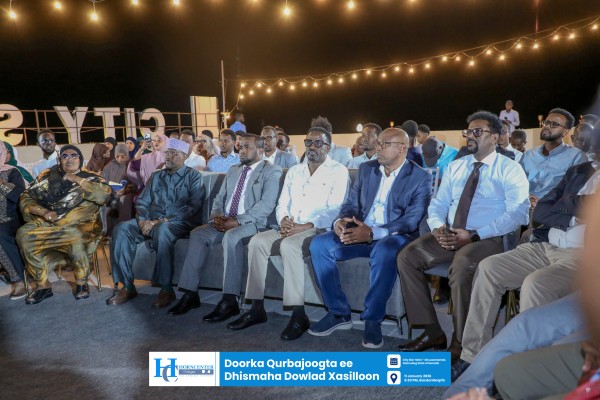
Government officials and distinguished guests, including ministers and leaders, gathered at the event. From left to right, you could see the Galgagduud region governor,
Mr. Elmi; Kasim Ali; Ambassador Ahmed Abdislaam; the executive director of HC
What I took away as a practitioner
Moderating this dialogue reminded us of the purpose behind HC Dialogue’s Quarterly Platform. It is not to produce statements or to celebrate the diaspora in the abstract, but to create a structured space for honest exchange between people doing the work — from different vantage points, with different tools, working towards the same goal.
As we extend R2P Phase II through 2026–2030 — concentrating on sustainable peacebuilding and governance reform — the ideas raised in this conversation will directly shape how we design our future interventions. Diaspora knowledge as institutional capital. Inter-governmental trust as infrastructure. Youth and women not merely as beneficiaries but as architects.
If you are working on any of these issues — in Somalia, in the Horn, or in diaspora communities — I would genuinely value the conversation. Drop a comment, or reach out directly.
About Horncenter (HC) Dialogue
HC Dialogue is a platform advancing governance, peacebuilding, and diaspora engagement in the Horn of Africa through structured, evidence-based public dialogue. Our next Quarterly Platform is coming soon — follow to stay updated.